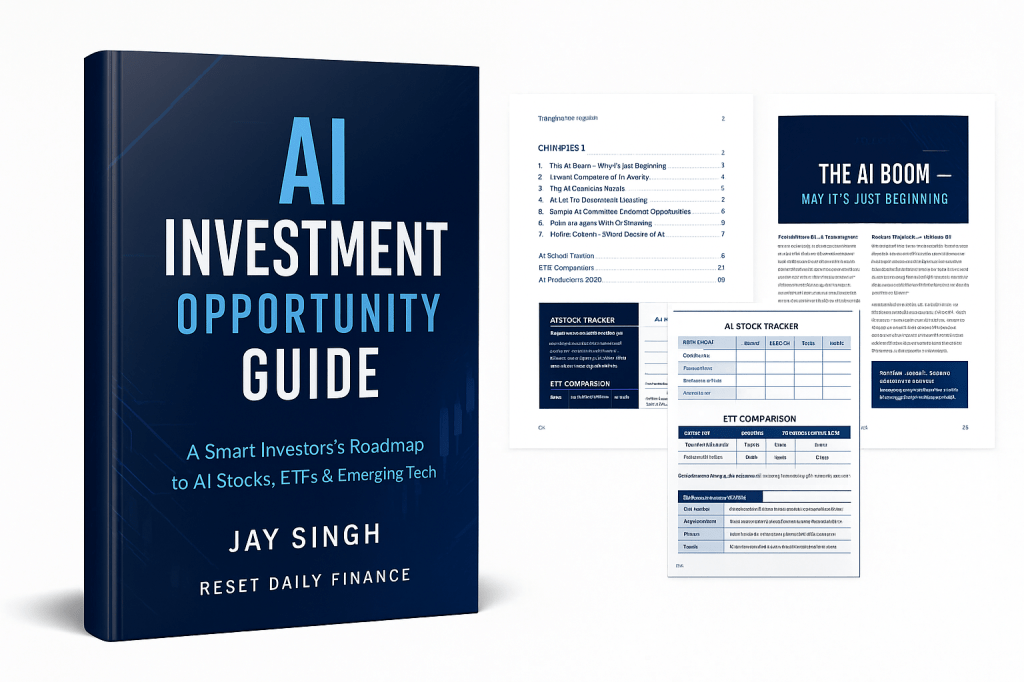
AI INVESTMENT OPPORTUNITY GUIDE
A Step-by-Step Roadmap to AI Stocks, ETFs & Emerging Tech
By Jay Singh | Reset Daily Finance
DISCLAIMER
This guide is for educational purposes only and does not constitute financial advice.
Always consult a licensed financial advisor before making investment decisions.
TABLE OF CONTENTS
- Strategy & Risk Profile
- Accounts & Tools
- AI Landscape (Layers & Moats)
- Watchlist Building
- Fundamental Research
- Valuation 101
- Timing & Entries
- Portfolio Construction
- Placing Orders
- Risk Controls
- Rebalancing
- Taxes & Records
- Red Flags
- Long-Term Trends
- Worksheets & Glossary
STEP 1 — STRATEGY & RISK PROFILE
Choose your main investing objective: Growth, Balanced, or Conservative Income.
Define your time horizon and the maximum drawdown you can tolerate (for example, -20%).
Commit to reviewing your plan annually — not emotionally during market swings.
Checklist:
- Goal selected
- Time horizon defined
- Max drawdown written
- Emergency fund ready
- One-page investing plan created
STEP 2 — ACCOUNTS & TOOLS
Set up your main brokerage account (Fidelity, Schwab, Robinhood, etc.) with two-factor authentication.
Link your bank account and enable Dividend Reinvestment (DRIP) if you plan to hold long-term.
Accounts and Settings:
- Brokerage open
- 2FA enabled
- Bank linked
- Tax-advantaged account (IRA, 401k if applicable)
- Dividend reinvestment active
Research and Tracking Tools:
- Company filings (10-K, 10-Q)
- Earnings calendars
- News alerts
- Portfolio tracker (Google Sheets or Excel)
- Watchlist app (Yahoo Finance, MarketWatch, or TradingView)
STEP 3 — AI LANDSCAPE (LAYERS & MOATS)
AI’s value is distributed across four main layers.
- Chips and Compute — NVIDIA, AMD, custom AI silicon
- Cloud and Models — Microsoft Azure, AWS, OpenAI
- Data and Analytics — Palantir, Snowflake, data-driven ecosystems
- Applications and Robotics — Tesla Autopilot, humanoid robotics, AI assistants
Key Moats:
- Proprietary data
- Integration into workflows
- Brand trust
- Global distribution
STEP 4 — WATCHLIST BUILDING
Start small and mix AI leaders with diversified ETFs.
Example Watchlist:
NVDA – NVIDIA – Core AI compute
MSFT – Microsoft – Cloud and Copilot ecosystem
GOOGL – Alphabet – Search, Ads, Cloud AI
PLTR – Palantir – Data analytics and AI modeling
AMZN – Amazon – AWS and logistics AI
TSLA – Tesla – Autonomy and robotics
BOTZ – Global X Robotics & AI ETF
IRBO – iShares Robotics & AI ETF
ARKQ – ARK Autonomous Technology & Robotics ETF
STEP 5 — FUNDAMENTAL RESEARCH
Focus on consistent performance trends, not single metrics.
Key Metrics to Track:
- Revenue growth (aim for double-digit yearly growth)
- Gross margin (stable or improving)
- Operating margin or Free Cash Flow (positive trend)
- Research and Development (healthy reinvestment)
- Net retention (B2B should be 110% or higher)
- Customer concentration (less than 20% from one client)
- Unit economics (LTV/CAC greater than 3 for SaaS firms)
- Leverage (manageable debt levels)
- Dilution (limited share issuance)
- Moat indicators (data, ecosystem, scalability)
STEP 6 — VALUATION 101
Avoid overpaying. Use multiple valuation perspectives.
Methods to Apply:
P/E Ratio – for mature, profitable companies
EV/Sales – for high-growth stocks
DCF (Discounted Cash Flow) – to test scenarios
Peer Comparison – to benchmark against competitors
Checklist:
- Three or more valuation methods used
- Scenario analysis completed
- Margin of safety identified
- Catalysts and risks documented
STEP 7 — TIMING AND ENTRIES
Use Dollar-Cost Averaging (DCA) to build positions over time.
Avoid hype-driven buys after big news or earnings.
Use simple signals like support/resistance, moving averages, and trading volume.
STEP 8 — PORTFOLIO CONSTRUCTION
Choose a model that matches your goals and rebalance quarterly.
Models:
Growth Portfolio: 45% core leaders, 35% satellite innovators, 15% ETFs, 5% cash
Balanced Portfolio: 35% core leaders, 25% innovators, 30% ETFs, 10% cash
Conservative Portfolio: 20% core leaders, 10% innovators, 55% ETFs, 15% cash
STEP 9 — PLACING ORDERS
Use limit orders instead of market orders to avoid poor execution.
Double-check ticker, quantity, and price.
Consider Good-til-Canceled (GTC) orders for staged entries.
STEP 10 — RISK CONTROLS
Protect your capital. No single position should be able to ruin your portfolio.
Guidelines:
- Max 10% per stock
- Max 40% total in satellite holdings
- Set alerts at -10% and -15%
- Hold cash or ETFs as hedges
- Avoid leverage or complex options as a beginner
STEP 11 — REBALANCING
Quarterly review your holdings.
Trim winners, add to strong-thesis laggards, and log all decisions.
This process keeps emotions out of investing.
STEP 12 — TAXES AND RECORDS
Track every trade, holding period, and cost basis.
Download annual 1099 forms from your broker.
Use tax-advantaged accounts where available.
STEP 13 — RED FLAGS AND COMMON MISTAKES
- Buying based on hype or social media trends
- Ignoring financial losses or cash burn
- Overtrading during market noise
- Concentrating in one narrative or company
- No exit strategy
STEP 14 — LONG-TERM AI TRENDS (2025–2035)
Areas to Watch:
- Compute scale and energy efficiency
- Autonomous and agentic AI systems
- Edge devices and wearables
- AI in healthcare diagnostics
- Industrial automation and robotics
- Regulation and ethical AI frameworks
STEP 15 — WORKSHEETS
STOCK TRACKER TEMPLATE
Company | Ticker | Buy Range | Target | Stop | Notes
ETF COMPARISON TEMPLATE
ETF | Focus Area | Top Holdings | Expense Ratio | Notes
NOTES PAGE
Use this page to record ideas, watchlist changes, or investment lessons.
GLOSSARY
DCA – Dollar-Cost Averaging: investing at regular intervals.
Moat – Competitive advantage that protects long-term profits.
EV/Sales – Enterprise Value to Sales, used for high-growth firms.
FCF – Free Cash Flow, cash left after expenses and capital costs.
Rebalancing – Adjusting your portfolio to restore target allocations.
ABOUT THE AUTHOR
Jay Singh is the founder of Reset Daily Finance.
He combines mindset coaching with smart, practical investing strategies.
His mission is to help everyday investors harness AI-driven opportunities for lasting wealth.
Reset Daily Finance | Momentum Meets
 Jay Singh Blogs